
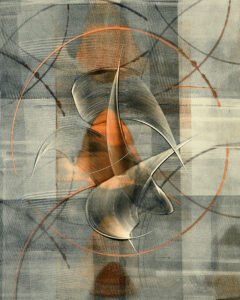
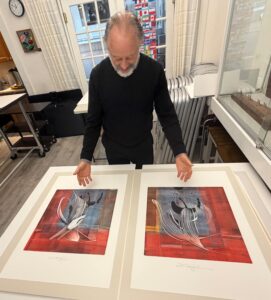
 David Chamberlain’s expressive paintings engage in a robust dialogue between painting and music. They exude a depth that rightly places him alongside those modern masters whose paintings also speak with an authentic musical vocabulary. Wassily Kandinsky, recognized as the first expressionist, called his paintings as “visual music.” Paul Klee was a violinist who felt the vibrations of music when he painted. Charles Burchfield said he saw sound when painting his hallucinatory watercolors. Mark Rothko felt he worked in rhythm as a jazz improviser. So did Jackson Pollock. It is in the same spirit of synesthesia that David Chamberlain proves a contemporary master who has also erased the boundaries of art and music. His medium and innovative technique are complex, setting him apart in a practice that combines both painting and printmaking. These are monotypes painted on heavy rag papers in a technique of his own invention. Instead of using brushes, his tools are spatulas, towels, and even his fingers as he applies pigments of varying colors and viscosities. Then, wielding various hand-made rakes, combs, and even his fingernails, he scrapes away pigments leaving white tracks — all while looking up to overhead mirrors. For certain effects, he even controls the flow of the pigments through dilution and blowing. Ultimately, the paintings he calls “visual wavelengths” are tactile yet transcendental expressions of musical exuberance. In this spirit, the following anthology is composed of excerpts from essays and critical reviews — as well as the artist’s own words — that clearly illuminate his extraordinary style of painting. Not only is his technique unique, but he is a rara avis among painters, having attracted artists from Japan, Vietnam, South Africa, England, and America to collaborate with him in creating paintings that are musical duets.
— Peter Hastings Falk, Editor
David Chamberlain’s introduction, “The Chamberlain Method of Monotype Oil Painting” is from the catalogue, 52 Weeks and 52 Paintings, 2016
Throughout history artists have endeavored to make meaningful marks. Our imaginations love to be triggered by compelling symbols, provocative strokes, and elegant lines. We can articulate, configure and arrange combinations of these marks into powerful images that we call compositions.
I am a composer of marks inspired by musical patterns and relationships. Music is by nature abstract and intangible, yet it speaks to us in profound ways. It is no accident that the languages of Art and Music share many phrases and components: line, form, rhythm, color, harmony… variations on a theme.
My hope is that viewers will respond to my artwork in musical ways… that they will see and follow the melodic lines, hear the harmonies, and delight in the orchestrations.
These are oil paintings on paper, created in my studio via the illuminating yet elusive process known as the Chamberlain Method of monotype oil painting. I sculpt oil paint pigments on a clear plate over a frosted light table, referring to overhead mirrors and using my hands, finger tools, and rollers — but no brushes. The whole idea is to make elegant, virtuoso marks, by hand… No quick & easy, no computers or short cuts, no place to hide.
When the composition is ready (complete to the point at which any additional marks can no longer improve it) the painted plate is placed on the etching press and wet handmade paper is positioned over it. The oil and water resist each other, and the pressure of the roller transfers the painted image onto the paper.
This process, more complex and difficult than it may seem, renders exceedingly fine detail that is not possible with other artistic approaches. It engenders a painterly quality celebrating the point that the image was made by hand & eye.
My hope is that viewers will respond to my artwork in musical ways… that they will see and follow the melodic lines, hear the harmonies, and delight in the orchestrations.
Note: Please imagine these painting compositions in their actual size,
at about 18 x 22 inches within an overall paper format of 22 x 30 inches.

Essay by James A. Winn, 2009:
While others strive to think “outside of the box,”
Chamberlain thinks outside of the systems
that make and label boxes.
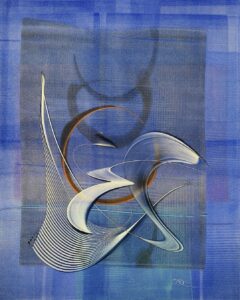
Chamberlain has worked extensively as a sculptor, producing stunning three-dimensional compositions in a variety of sizes, materials and directions, and as the works in this book triumphantly show, he is also a deeply original and persuasive painter. His inventiveness begins at the most basic level: he works without brushes, a fundamental departure from standard practice that enacts his need to articulate his materials directly and kinetically; he is a tactile painter. At a larger level, his oeuvre investigates the history and theory of dimensionality: critics have praised his sculpture for its soaring sense of line, and his paintings for their depth.
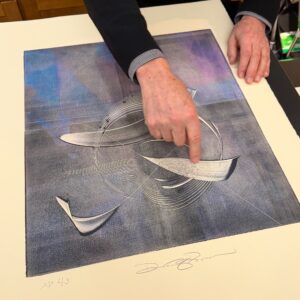 His deliberate blurring of the distinction between painting and sculpture is another instance of his passionate search for fresh paradigms, but he also understands that his quest sometimes requires the making of many similar works, in which tiny variations point the way toward the next radical departure. Although his artistic products are finished works, Chamberlain sees each of them as part of an ongoing artistic process, a journey in which he celebrates the unexpected bends in the road.
Perhaps his most radical departure from Western assumptions about art lies in his willingness to abandon his claims as a solitary, heroic maker of art by entering collaborations with others, including not only visual artists but poets, dancers, and musicians. The resulting “duett paintings,” made together as a team on a single occasion by a process of shared improvisation derived from jazz, are not only fine works in their own right, but have evidently been heuristic exercises for Chamberlain, allowing him to incorporate the visions of others into his own ongoing journey and discoveries.
I have watched the unfolding of David Chamberlain’s expansive aesthetic consciousness for forty years, and that experience has given me many joys, not least of which is the knowledge that I cannot predict the next development in his growth as an artist and a person—except to say that it will be exhilarating.
Essay by Richard Spurgeon, 2009:
Many works of art depict the forces of nature in fairly abstract terms. For example, in Leonardo’s notebooks, abstract sketches of water, wind and clouds bear the imprint of his restless, inquiring imagination and rapt interest in both the chaos and the order of nature. In Hokusai’s famous print, The Great Wave off Kanagawa, the menace of waves is conveyed in a huge, sweeping abstract curve, while in the background, Mt. Fuji itself seems at once dwarfed by the wave and yet a pivot point of enduring stability. Some ancient Chinese scrolls show dragons cavorting amid abstract clouds and water, the creatures themselves elusive and only partly revealed, playful, yet emblematic of celestial order.
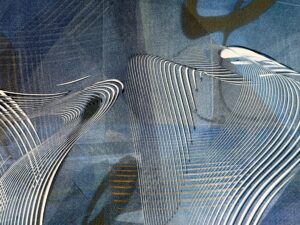
On a greater level of abstraction, some of Chamberlain’s works bring to mind forces in physics. There is often a sense of vortices, of flux and turbulent energy, and of form emerging out of primordial mist. Oddly, two extremes of scale seem most involved: the work could recall swirling spiral nebulae or particles at a sub-atomic level, or both. The artist himself has confirmed in conversation the validity of such interpretations.
The Collaborations
The following synopsis draws upon an article by Ellen Grimm, “Painter Employs Unlikely Tools to Create ‘Riffs’” (Nashua, NH: Telegraph Correspondent, 3 Dec 2006)
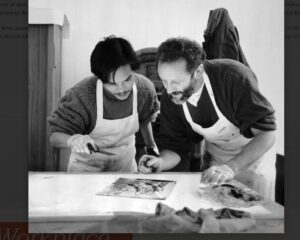
David Chamberlain had long worked in duets with other composers, jazz musicians, and poets in duets. He became increasingly fascinated by the creative process of how, just as the minds of musicians sought patterns, so too could painters unite to combine elements to create something new — like jazz riffs. He envisioned two masters working together on the same painting at the same time, blending their styles and cultural backgrounds to create abstract paintings as musical compositions.
“The idea of working collaboratively with other practitioners of the compositional arts came to me in 1994 while serving as a panelist at the annual Conference on World Affairs in Boulder, Colorado. Musicians were performing and improvising together with a focus on jazz, like inventive dancers doing a pas-de-deux. I thought that there ought to be a way for creative people to compose together as well as perform, allowing visual artists to collaborate in the studio process.”
Chamberlain’s first painting collaborations took place in 1995 when he traveled to Vietnam to work with Do Minh Tam, who he described as among the “rising stars in the country’s emerging modernist culture.” Chamberlain originally called these works the “Duett Paintings” — adding a second “t” to emphasize the philosophical, spiritual, and aesthetic essence of a creative pair but reverted to the accepted spelling with one t only because of persistent corrections in the press and spell-checks. Chamberlain notes, “If anything is to be accomplished, we must first look inside each other and make up rules that work for us as a team. Positive collaboration is not compromised. It is win-win and can take us to a new place of understanding that neither of us visits alone.”
In 1996, Chamberlain was in Tokyo working with Emi Tajima, recognized as Japan’s youngest master-level calligrapher. Their two-person exhibition appeared at the Muse a Muse Art Gallery in Tokyo’s upscale Ginza district with positive reviews in Asahi Shinbun, one of the world’s largest newspapers. The major series they created together is the Habitaki Suite, inspired by “two wings flapping together.” They went on to exhibit their paintings in a dozen institutions, including the Hara Museum (Tokyo), the Ashmolean Museum (Oxford University, England), and the Denver Art Museum. The Asian Art Museum in San Francisco acquired five of these paintings, which are the first collaborative works by a Japanese artist and an American artist in the museum’s collection.
The Sculpture: Melodic Forms
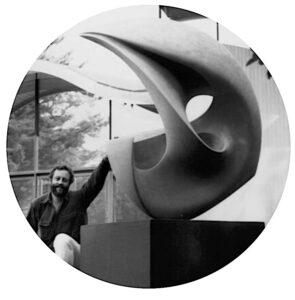
The following abstract is from the essay, “David Chamberlain: Maker of an Elegant Order” — by Jacqueline Malone, published in the book, Melodic Forms: The Sculpture of David Chamberlain (Boston: David R. Godine Publishers, 1990, for the solo exhibition at the McKissick Museum of Art, Columbia, South Carolina)
“It is remarkable to me that so much energy can flow from a static object, that life can be embodied in a bronze, that music can spring from a block of wood.” With these words, sculptor David Chamberlain captures that special energy in his fluid, organic sculptures.
This book shows the range and ingenuity of Chamberlain’s art. Working in mahogany, marble, gold, ceramic, and bronze, the artist shapes materials in distinct, new ways. Drawing inspiration from modern, abstract sculptors like Henry Moore and Alexander Archipenko, Chamberlain creates forms that celebrate space and motion. Works turn inward, twist in spirals, and extend into peaks. Chamberlain’s ability to lead our eyes in a continuous flow from inner to outer, from concave to convex, from positive to negative, places his art in the context of contemporary sculpture.
Chamberlain’s work stirs associations. We think of nature’s organic shapes and rhythms — sea shells, human forms, animal horns, and the ebb and flow of the sea. We become involved in his spaces, moving in and around them. The interiors of his pieces are as important as the exteriors, and Chamberlain draws our eyes over both, luring and surprising us.
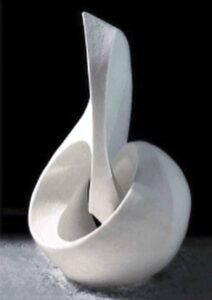
All of Chamberlain’s surfaces are treated with a painter’s eye. Bronzes may be fiery gold, quiet green, or an interaction of both. Marble pieces may be cool and white, creating a subtle drama of shadows. The artist evokes moods. He composes melodies of harmony and depth in rich, varied materials.
As a sculptor, David Chamberlain is attracted to whatever exhibits an elegant simplicity. A line or geometry of elegance can exist in the ideas of physics, in the secreting growth of a seashell, in the tonal progression of a concerto, in the unfolding of a human life. The vitality of his abstract work comes from an expectant perception of the everyday world.
Nothing about Chamberlain’s art is purely a product of the unconscious mind, though the flow of the lines does sometimes suggest the sinuous languor of reverie or dream. Even the casual viewer is aware of a precision and elegance that is planned and executed with exquisite detail.
Sculpture is a difficult art. It requires an ability to imagine in three dimensions, even — Chamberlain would say — to imagine in the fourth dimension: time. A sculptor must not only be able to see every angle, but he must also be able to see how our eye travels over time. Like the composer of a concerto, the sculptor must provide variety that seems surprising and at the same time inevitable. He must provide strong visual excitement from every possible angle.
For the sculptor, there is no place to hide. The eye of the viewer is relentless. It may begin at almost any place. Though a work has climaxes — places of great exhilaration — it has no beginning, middle, or end. The movement of the eye across time is important, but time is linear only in a limited way. In sculpture there is no backward or forward, and the eye can travel either way along a line that defines an edge. Even the line may turn back upon itself so that the time in the sculpture is self-contained…
The simplicity and elegance of David Chamberlain’s sculptures are intoxicating. As a maker of elegant forms, he offers images of truth and beauty in an often rough and complex world.
Select Museums with Chamberlain sculptures:
McKissick Museum of Art, Columbia, SC (sponsor of traveling exhibition)
Wadsworth Atheneum, Hartford, CT
Williams College Museum, Williamstown, MA
Smith College Museum, Northampton, MA
Delaware Museum of Art, Wilmington, DE
Nelson-Atkins Museum of Art, Kansas City
Johnson Museum of Art, Ithaca, NY
Muskegon Museum of Art, Muskegon, MI
Currier Gallery & Museum, Manchester, NH
Colorado Springs Fine Arts Center