
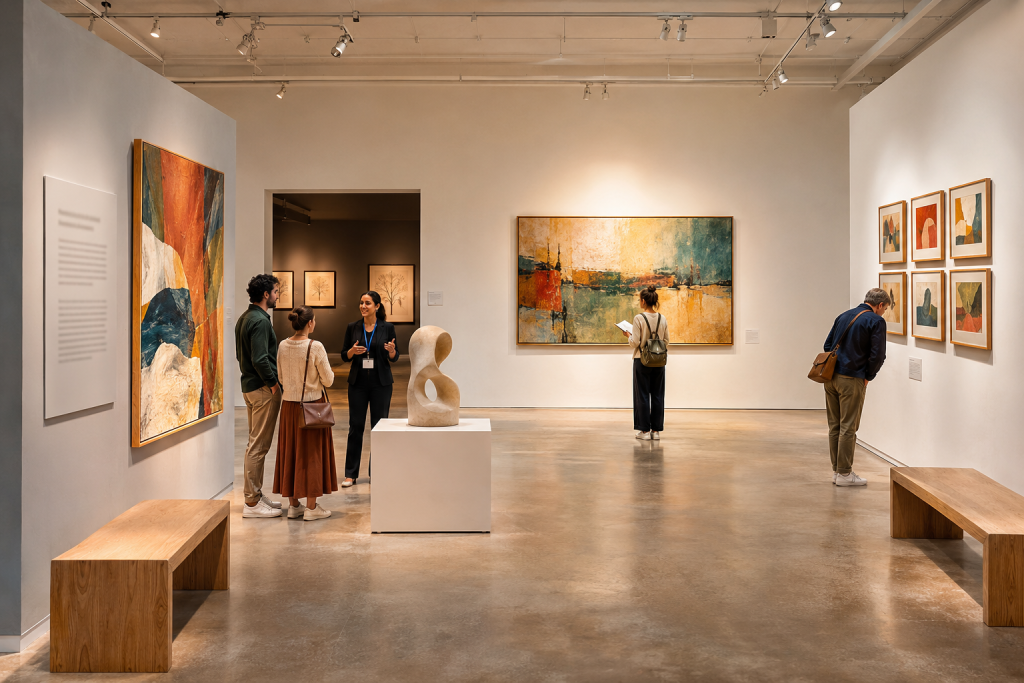
An art exhibition is a planned public display of artworks, organized around an artist, a theme, or a period, and shown in a gallery, museum, or other space. Defining an art exhibition is easy. Understanding one takes a little more — slow down, look before you read, and notice how the space is arranged. That arrangement is part of what the show is telling you.
What Is an Art Exhibition, and What Does “Exhibit” Mean?
An art exhibition is a public showcase of artworks someone has chosen and arranged, usually around one or more artists, one thematic concept, or one period.
Several Curators may be involved. They choose the theme and shape the story around the art. If living, the artists sometimes help plan the show. Galleries and museums provide the space and the audience. An exhibition can aim to show the piece, teach, sell, or start a conversation, and many do more than one.
The vocabulary sometimes causes confusion. In stricter usage, an exhibition is the whole show while an exhibit is one object or a small display inside it. Both words are correct, but in North America an art exhibit definition usually means the whole show.
Exhibitions also do more than just display someone’s art. They are one of the main ways an artist’s work enters the public record. For example, the Paris Salon, open to the public from 1737, helped decide which French artists were taken seriously. And the 1913 Armory Show in New York was the first major exhibition of European modern art in the United States.
Exhibition vs. Gallery vs. Museum Show
The gallery and museum name the location. Exhibition, show, and exhibit describe what is on view there. A museum may keep a permanent display and also host special exhibitions. A commercial gallery fills its rooms with work that is for sale, and entry is almost always free. Museums typically charge an entry fee, especially for costly exhibitions. These are common patterns, not rules, so check the venue’s website before you go.
Types of Art Exhibition Formats
Exhibition formats differ in who is shown and how long the show runs. Knowing the format tells you what to expect.
- Solo show: Work by one artist. For you: you get a close look at one voice, so see if quality repeats itself.
- Group show: Work by several artists, usually three or more. For you: look for what connects them.
- Retrospective: A show that looks back over one artist’s career. For you: it is often arranged chronologically, though some are arranged thematically, so check how the rooms are organized.
- Thematic show: Work gathered around one idea. For you: the consistency of the concept matters as much as any single piece.
- Permanent and temporary: A permanent display stays up for a long time, though museums still change it over the years. A temporary show runs for a limited period. For you: temporary shows end, so plan ahead.
- Traveling show: A show that moves on to several venues. For you: the same show can feel different in each building.
- Pop-up or off-site show: A short display in an unexpected place, such as a shop or an empty building. For you: these are brief, so check the dates before you go.
- Virtual show: A show that exists online, often in a gallery’s viewing room. For you: you can see from home, but you lose the sense of scale.
Other exhibition formats also exist. Juried shows have a judge who selects the work while invitational shows invite selected artists to participate. A biennale is a large exhibition held every two years, and an art fair often puts 100 or more galleries under one roof to sell work.
Retrospectives are also one way overlooked artists get a second look. To see the kinds of artists who do, browse this leading directory of rediscovered artists.
How an Art Exhibition Is Planned and Set Up
Before you see a single work, there’s a team behind it that makes a couple of decisions. A show moves through five stages: concept, space, budget, selecting the art, installation, lighting, and the opening night. All this exhibit planning shapes what you see. Exhibiting artwork well takes more than hanging it on a wall. Small independent shows often take twelve months to plan. Major museum shows that borrow art from other institutions can take around three to five years.
What Curators Decide Before You Walk In
Good exhibition planning starts with the theme. Then curators decide which works hang beside each other, in which gallery rooms, and how much text goes on the wall. This exhibition work happens long before opening day. Wall text is short on purpose. Visitors will not read long passages while standing up, so curators have to leave things out. Every label is a choice about what you most need to know.
Exhibition Setup: Why It Looks the Way It Does
Many museums hang work near eye level, often with the center of the piece about 58 to 60 inches from the floor, though the number varies. Spacing, wall color, sculpture stands, and lighting all change how a piece feels. A painting on its own wall draws attention, while a painting displayed with others feels like part of a group.
How to Read an Exhibition Layout
An exhibition is arranged to make a point. Once you know that, the room gets easier to read. These five clues can help you. They are clues, not rules, because every curator has a different approach.
- The entrance piece: It often sets the show’s theme. It is not always the most important work.
- Spacing: A work alone on a wall asks for a long look. A tight cluster asks you to compare.
- Grouping and room order: Works may be arranged by date, by theme, or by medium. Ask what the order is trying to show.
- Lighting: Light draws your eye, but a dim room does not mean the work matters less. Museums often keep light low to protect fragile work, especially art on paper.
- Wall text length: A long text beside one work and a short label beside another shows where the curator thinks you need help.
You can try it on your next visit. Stand at the entrance and ask what the first piece is doing. Then look for the artwork with the most space around it and ask why. Seeing how pieces are arranged also reveals the exhibition’s intent. For example, a show that places an artist’s early experiments beside later work is making a claim about how that artist developed. The arrangement is the evidence.
How to Understand an Art Exhibition Step by Step
To understand an art exhibition, pick a few works instead of trying to see everything; walk the room once, then slow down at the pieces that hold you. Look first, ask simple questions, read the label last, and talk with staff or write notes afterward.
Research gives us some context. An independent academic study conducted at the Metropolitan Museum of Art found that visitors spent an average of 27.2 seconds viewing a masterpiece, with a median time of just 17 seconds. A 2016 follow-up study confirmed these fast-viewing habits have barely changed, averaging 28.63 seconds.
While world-famous in museum psychology, the research was published in the journal Empirical Studies of the Arts and isn’t featured on The Met’s official website. Instead, the full 2001 study text can be accessed through SAGE Journals.
You do not need to see everything, and you can do better than that pace for the art you care about.
Set Expectations Before You Go
Wear comfortable shoes and bring a small notebook. Visitors have reported ‘museum fatigue,’ the tiredness that comes from looking at too much art, since at least 1916. Plan a break so you stay fresh.
Walk the Room First
Take a quick lap before you stop anywhere. You are looking for the overall feel of the show and for the pieces that pull you in.
Slow Down and Look at Each Work
For the few works that grab your attention, try spending one to three minutes. Take in the whole composition first, then move to details such as brushwork, lines, and textures.
Ask Simple Questions
What is the setting? Who or what stands out? What colors and moods do you notice? What was your first reaction, and why?
Read the Label Last
Form your own view, then compare it with the curator’s wall text. The researchers behind those museum studies suggest reading the label, then looking a bit more.
Talk to a Trained Guide and Reflect Afterward
Ask a docent, one of the trained guides who work in many galleries and museums, if they have a moment. Review your notes later, share a favorite with a friend, and look up more work by the artist. You can find more artists in the directory of rediscovered artists.
How to Analyze an Artwork: A Quick Framework
A simple method for looking at any single work comes from Edmund Burke Feldman, an art educator at the University of Georgia. It has four steps:
- Describe: List what you see, without judging it.
- Analyze: Notice how color, line, shape, and space relate to each other.
- Interpret: Decide what the work seems to be about, using what you saw.
- Judge: Say how well the work succeeds, and why.
Judgment comes last on purpose. A quick verdict before you look closely is just an opinion. Art historians bring the same habit to an artist’s whole body of work — evidence first, then a conclusion. For more on that approach, read about how to appreciate and appraise an artwork.
How to Write an Art Exhibition Review
A short review needs three parts — your first impression, what stood out and why, and whether it is worth recommending. This is an example of a brief exhibition review:
“The first room felt crowded, but the quiet landscapes at the back were worth the walk. The paintings improved the longer you stood with them. Recommended for anyone who likes to pause for a moment and appreciate art slowly.”
How to Create an Art Exhibition: An Overview
If you want to organize a show yourself, exhibit planning comes down to a few short steps, and the last two make the difference.
- Write a concept statement that says what links the work.
- Set a budget that covers materials, installation, transport, marketing, and insurance.
- Choose a space and a timeline. Smaller shows often need six to twelve months.
- Plan the installation and the labels.
- Promote the show and plan the opening.
Afterward, take photos, follow up with visitors, and archive the records. Good records are most important when a show brings forward an artist few people know. For that fuller story, see how rediscovery projects move from private estate to public exhibition.
Final Thoughts
Exhibitions reward curiosity more than expertise. The room arrangement, label length, and order of the art are all part of what you see. Visit one this week, choose three artworks, and give each of them a full minute. Behind many shows there’s a body of work that someone had to organize and document, which is the subject of artist estate collection management.
Frequently Asked Questions
What does “exhibit” mean in art?
An exhibit is a single object or display shown to the public. In North America, it also commonly refers to an entire exhibition.
How long should you spend at an art exhibition?
There is no fixed time. Research finds the average visitor looks at a work for under 30 seconds. For the few art that hold you, aim for a minute or more.
Do I need art knowledge to enjoy an exhibition?
No. Look carefully and ask simple questions. Labels, guides, and later reading can add context.
What are the common types of art exhibitions?
The main exhibition formats are solo shows, group shows, retrospectives, thematic shows, permanent and temporary displays, traveling shows, pop-ups, and virtual exhibitions.
