

For most of painting’s history, a canvas was expected to describe something, a person, a place, an event. Abstract art broke that expectation.
Rather than showing the world as it appears, abstract artists work directly in color, shape, line, and texture, treating the painting itself as the subject rather than a window onto something else.
An abstract art painting is a painting that does not represent reality exactly. Some abstract works still hint at familiar subjects, while others contain no recognizable objects at all. The goal is not to copy the world but to help you experience it differently.
Definition of Abstract Art Painting
Abstract art is a style of painting that moves away from realistic representation to focus on color, shape, line, texture, and composition.
Abstract art replaces realistic images with visual expression. The abstract art definition includes both partially abstract and completely non-representational paintings. Some artists simplify real subjects until they are barely recognizable, while others remove them altogether.
In both cases, the goal is not to copy reality but to express an idea, emotion, or experience.
When I study an abstract painting, I rarely view it on its own.
Looking at an artist’s complete body of work often reveals how their ideas changed over time. A painting that seems puzzling by itself may become much easier to understand when seen alongside the rest of the artist’s work.
Also Read: How to Appraise Your Art Collection
Characteristics of abstract paintings
People often assume abstract art has no rules because it does not look realistic. I have found the opposite to be true.
The strongest abstract paintings are carefully considered, even when they appear spontaneous. Every color, shape, and brushstroke has a purpose within the composition.
Although no two artists approach abstraction in the same way, many abstract paintings share these characteristics:
- They simplify or completely remove recognizable subjects.
- They use color, line, shape, and form as the main visual language.
- They emphasize emotion, rhythm, movement, or atmosphere over realistic detail.
- They rely on composition to create balance and direct the viewer’s eye.
- They often reveal texture through visible brushwork or layered surfaces.
- They invite personal interpretation rather than offering one fixed meaning.
- They reflect an artist’s individual way of seeing the world.
Consider the difference between Piet Mondrian and Jackson Pollock. Mondrian built calm, ordered compositions from straight lines and primary colors.
Pollock covered large canvases with energetic drips and gestures. Their paintings could hardly look more different, yet both used abstraction to communicate ideas that realistic painting could not.
Types of Abstract Art
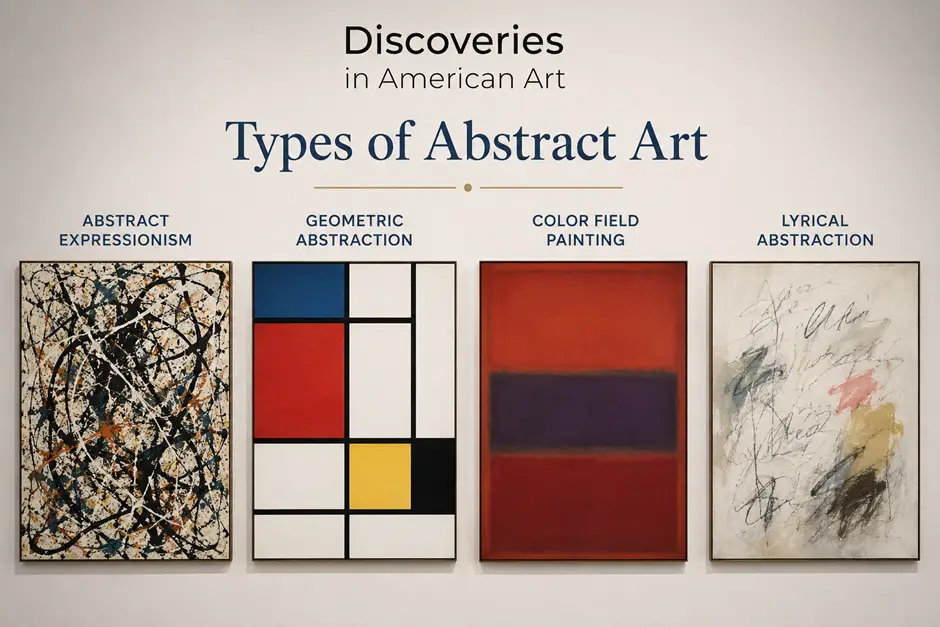
Abstract art includes several styles that developed as artists searched for different ways to move beyond realistic representation.
People often speak about abstract art as though it were a single movement. It was not. Artists arrived at abstraction through different questions, different influences, and different goals.
Understanding those differences helps explain why one abstract painting can look completely unlike another.
Abstract Expressionism
Abstract Expressionism is a style that values gesture, movement, and the physical act of painting.
Jackson Pollock did not simply invent a new way to apply paint. He challenged the idea that a painting had to begin with a carefully planned image.
His dripped and poured compositions turned the act of painting into part of the finished work, changing how later generations thought about the artistic process.
Geometric Abstraction
Geometric Abstraction is a style that builds paintings from simple shapes arranged with precision and balance.
Piet Mondrian reduced painting to straight lines, rectangles, and primary colors. At first glance, the compositions appear simple.
Looking more closely reveals that every line and proportion contributes to a carefully considered sense of balance. That discipline became as important as the forms themselves.
Color Field Painting
Color Field Painting is a style that uses large areas of color as the primary subject of the painting.
Mark Rothko demonstrated that color alone could shape a viewer’s experience. His paintings ask for time rather than quick observation.
Standing before one often reveals subtle shifts in light, scale, and atmosphere that cannot be appreciated in reproduction.
Lyrical Abstraction
Lyrical Abstraction is a style that emphasizes fluid forms, intuitive mark-making, and personal expression.
Cy Twombly approached abstraction differently. His paintings combine gestures, fragments of writing, and references to literature and history. The marks may appear spontaneous, yet they reflect an artist deeply engaged with memory and culture.
When I catalogue an artist’s estate, I often find that the turning point lies in the sketches, experiments, and unfinished works that never appeared in exhibitions, pieces that provenance research alone can bring back into view.
An artist’s work usually changes over decades, and those changes often reveal more than the movement to which the artist is assigned.
These movements help us organize art history, but they rarely explain a single artist fully. Cataloguing a career across decades, not just its best-known canvases, is usually what reveals why an artist ends up assigned to one label, and where they eventually broke from it.
A Short History of Abstract Art
Abstract art emerged as artists began asking whether a painting had to describe the visible world to be meaningful.
For centuries, painters were expected to represent people, landscapes, and historical events as faithfully as possible. By the late nineteenth century, that expectation began to change.
Photography could already record the world with remarkable accuracy, leaving painters free to explore something a camera could not: emotion, rhythm, memory, and imagination.
The transition was gradual rather than sudden. Artists such as J. M. W. Turner pushed landscapes toward light and atmosphere, allowing color and movement to take precedence over precise detail.
His paintings still depicted the natural world, but they hinted at possibilities that later artists would pursue much further. Between 1905 and 1915, abstraction took a decisive step forward.
Wassily Kandinsky believed that color and form could communicate without relying on recognizable objects, much as music communicates without words. Around the same time, Hilma af Klint produced remarkable abstract paintings that remained largely unseen for decades.
Today, both artists are recognized as pioneers who helped redefine what painting could be. History rarely changes through a single masterpiece.
When I study an artist’s estate, I often find that the turning point lies in the sketches, experiments, and unfinished works that never appeared in exhibitions.
Those pieces reveal how new ideas developed long before they became accepted. Abstract art was no exception. It grew through years of questioning, experimenting, and refining, one painting at a time.
Examples of Abstract Paintings
Abstract paintings reveal how different artists solved the same question in remarkably different ways.
No single painting can explain abstract art because abstraction has never followed one path. Each artist developed a personal response to the same challenge: how to communicate without relying on realistic images.
- Composition X (1939): Wassily Kandinsky
Kandinsky believed that painting could work much like music. In Composition X, color, shape, and line replace recognizable subjects, inviting viewers to respond through feeling rather than identification. - Composition No. II (1930): Piet Mondrian
It distills Mondrian’s method to its essentials, a handful of black lines and three primary colors, arranged with no room for accident. The painting looks deceptively simple in isolation; set beside the rest of his output, the same restraint reads as years of refinement rather than a single inspired choice.” - Blue Poles (1952): Jackson Pollock
Pollock transformed the act of painting itself. His dripped layers of paint recorded movement, making the creative process as important as the finished image. - Orange, Red, Yellow (1961): Mark Rothko
Rothko demonstrated that color alone could shape a viewer’s experience. His paintings reward patience, revealing subtle relationships that become clearer the longer one stands before them.
I have found that these paintings become even more meaningful when viewed alongside the rest of an artist’s work. A single masterpiece may capture attention, but an artist’s complete body of work reveals the questions they returned to throughout their career.
That is why artist estates matter. They preserve the larger conversation behind the paintings, not just the individual works that became famous.
Famous Abstract Artists
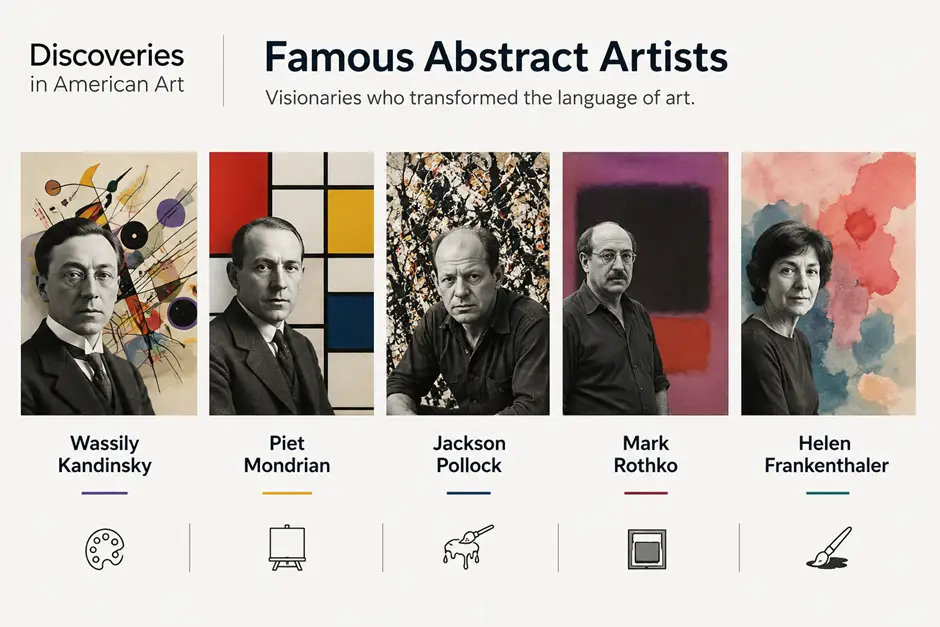
Famous abstract artists are remembered because they changed how later generations understood painting, not simply because they became well known.
Abstract art did not grow through the work of one artist alone. Each generation expanded the possibilities of painting differently, building on ideas that came before.
Wassily Kandinsky believed painting could communicate through color and form much like music communicates through sound. His work helped establish abstraction as an independent artistic language. [View Biography]
Piet Mondrian reduced painting to its essential elements. His carefully balanced compositions showed that simplicity could express harmony and order without depicting recognizable subjects. Discover Mondrian
Jackson Pollock redefined the act of painting itself. His energetic drip paintings demonstrated that movement and process could become part of the finished work. Discover More
Mark Rothko explored the emotional power of color. His large canvases invite quiet observation, revealing subtle relationships that become more apparent over time. [View Biography]
Helen Frankenthaler introduced new ways of working with paint by allowing color to soak directly into the canvas. Her experiments influenced an entire generation of American painters. [View Biography]
When I study an artist’s career, I am reminded that these artists did more than create memorable paintings. They developed new ways of thinking about art. Their lasting influence comes from the ideas they introduced and the artists they inspired.
Also Read: Most Famous Abstract Paintings
What Does Abstract Art Mean, in Simple Words?
Abstract art means using color, shape, line, and form to communicate ideas without relying on realistic images.
Many people believe they need to solve an abstract painting before they can appreciate it. I have found that understanding usually begins with careful observation, not quick answers.
Notice how the artist uses color, balance, movement, or texture, then ask why those choices were made. Over time, those observations often reveal the artist’s ideas more clearly than searching for a hidden subject ever could.
An abstract painting rarely stands alone. When viewed alongside an artist’s other work, it becomes part of a larger story of experimentation, change, and artistic development. That broader context is often where its meaning becomes most visible.
Final Thoughts
Abstract art becomes more meaningful when viewed within the context of an artist’s life and work.
People often ask me what an abstract painting means. I usually begin by looking at the artist rather than the image alone. A single painting offers one moment in an artist’s career, but a body of work reveals how ideas developed over time.
That perspective is what rediscovery means in practice at Discoveries in American Art not simply locating a forgotten canvas, but reconstructing the body of work and the historical context around it.
Frequently Asked Questions
Q1. What is considered an abstract painting?
A painting is generally considered abstract when it asks to be read through color, shape, and composition rather than through subject matter. Some works still carry a trace of the visible world; others leave it behind entirely. What separates the two categories is intent. Whether the artist set out to depict something or to construct an experience that stands on its own.
Q2. What are the seven characteristics of abstract art?
Abstract art tends to share seven qualities: simplified or absent subject matter, expressive use of color, deliberate line work, visible texture, a composition built for balance rather than depiction, room for personal interpretation, and an emphasis on emotion or concept over likeness. Few paintings show all seven equally; most lean on two or three as their defining language.
Q3. What are the four main types of abstract art?
Abstraction is usually grouped into four traditions: Abstract Expressionism, Geometric Abstraction, Color Field Painting, and Lyrical Abstraction. Each grew out of a different question about what a painting could do once it stopped describing the visible world, which is why the four can look almost unrelated despite sharing a common origin.
Q4. What are three famous examples of abstract art?
Three widely cited examples are Composition X by Wassily Kandinsky, Composition No. II by Piet Mondrian, and Blue Poles by Jackson Pollock. Each is usually studied on its own, but paintings like these are easier to place in context when seen against the artist’s fuller estate; the works that came before and after tend to explain why the famous piece looks the way it does.