
Surrealist Expressionist Paintings From Artist Estates
Some paintings resist easy classification. They combine the dreamlike imagery associated with Surrealism with the emotional intensity and personal expression often associated with Expressionism. These works occupy a fascinating space between imagination and feeling, where symbolic imagery, memory, intuition, and psychological exploration become central to the creative process.
At Discoveries in American Art , we frequently encounter paintings of this nature through artist estates. Many were created by artists who worked outside major gallery systems and institutional networks. Their paintings remained in studios, family collections, or storage for decades, often receiving little public attention despite their originality and artistic merit.
Today, these estate discoveries provide collectors and researchers with opportunities to explore works that expand our understanding of twentieth-century American art.
What Is Surrealist Expressionism
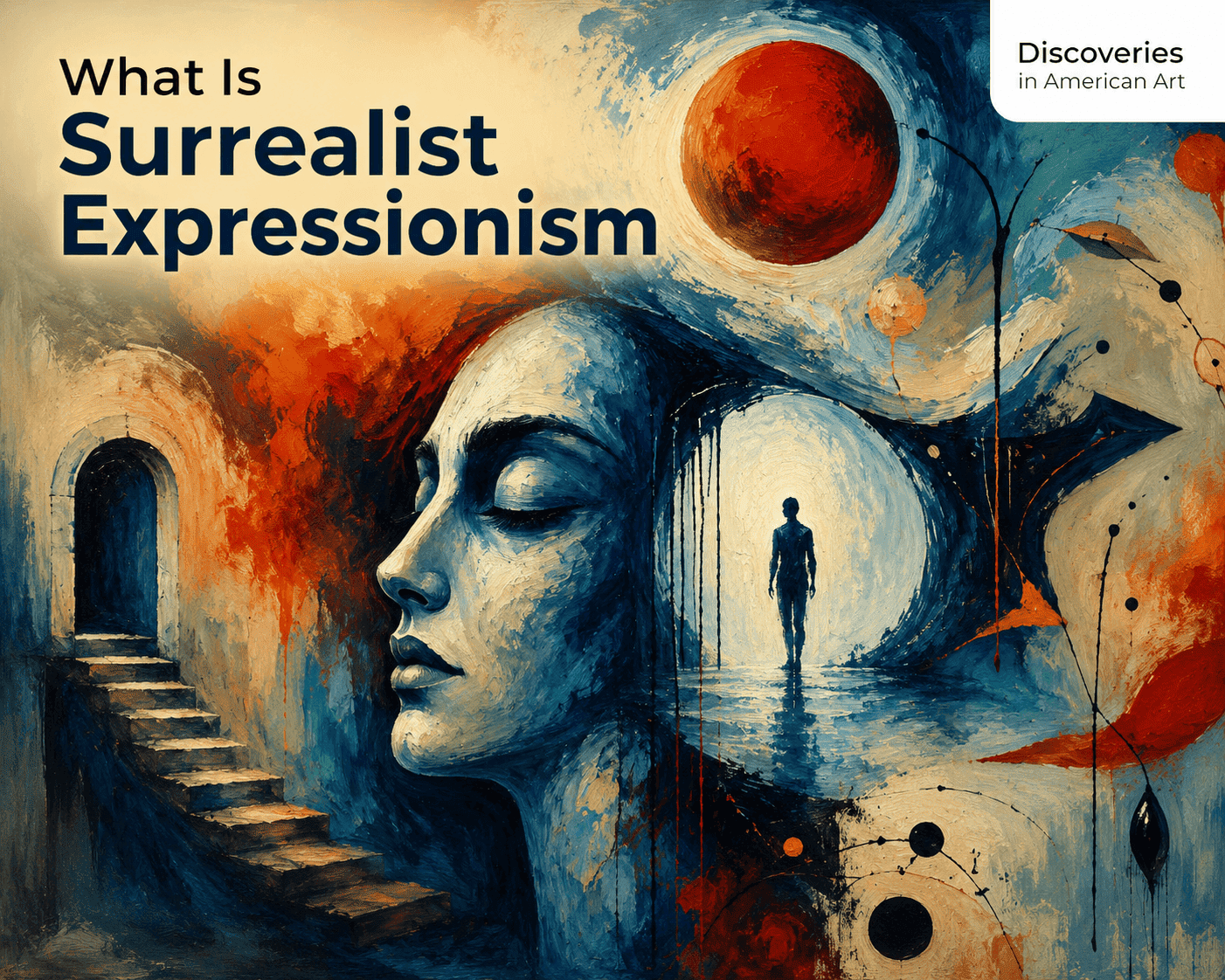
Rather than a formal movement, Surrealist Expressionism is best understood as a convergence of artistic ideas. It combines the imaginative and psychological qualities of Surrealism with the emotional energy and personal intensity associated with Expressionist painting.
Artists working in this manner often drew inspiration from dreams, memory, intuition, and subconscious imagery while using expressive color, gesture, and abstraction to communicate emotional experience.
Many surrealist expressionist paintings blur the boundary between recognizable imagery and abstraction. The result is artwork that feels both deeply personal and visually unpredictable, inviting viewers to interpret meaning rather than simply observe a subject.
Origins and Key Influences
The roots of this approach can be traced to several important developments in twentieth-century art and psychology.
Automatism and Free Association
Many Surrealist artists embraced automatism, a creative method intended to bypass conscious control and allow ideas to emerge freely. Drawing, painting, and writing were often approached as spontaneous acts guided by intuition rather than planning.
This emphasis on instinct later influenced numerous American artists who sought new ways to express emotion and inner experience through painting.
Dreamlike Imagery and Symbolism
Dreams, symbols, memory, and the subconscious became central themes for many artists working within Surrealist traditions. Strange landscapes, symbolic figures, fragmented forms, and unexpected visual relationships allowed artists to explore ideas that could not easily be expressed through conventional representation.
As these ideas intersected with more expressive forms of painting, artists developed highly personal visual languages that combined imagination with emotional intensity.
Notable Artists and Influences
Pioneers of Visual Surrealism
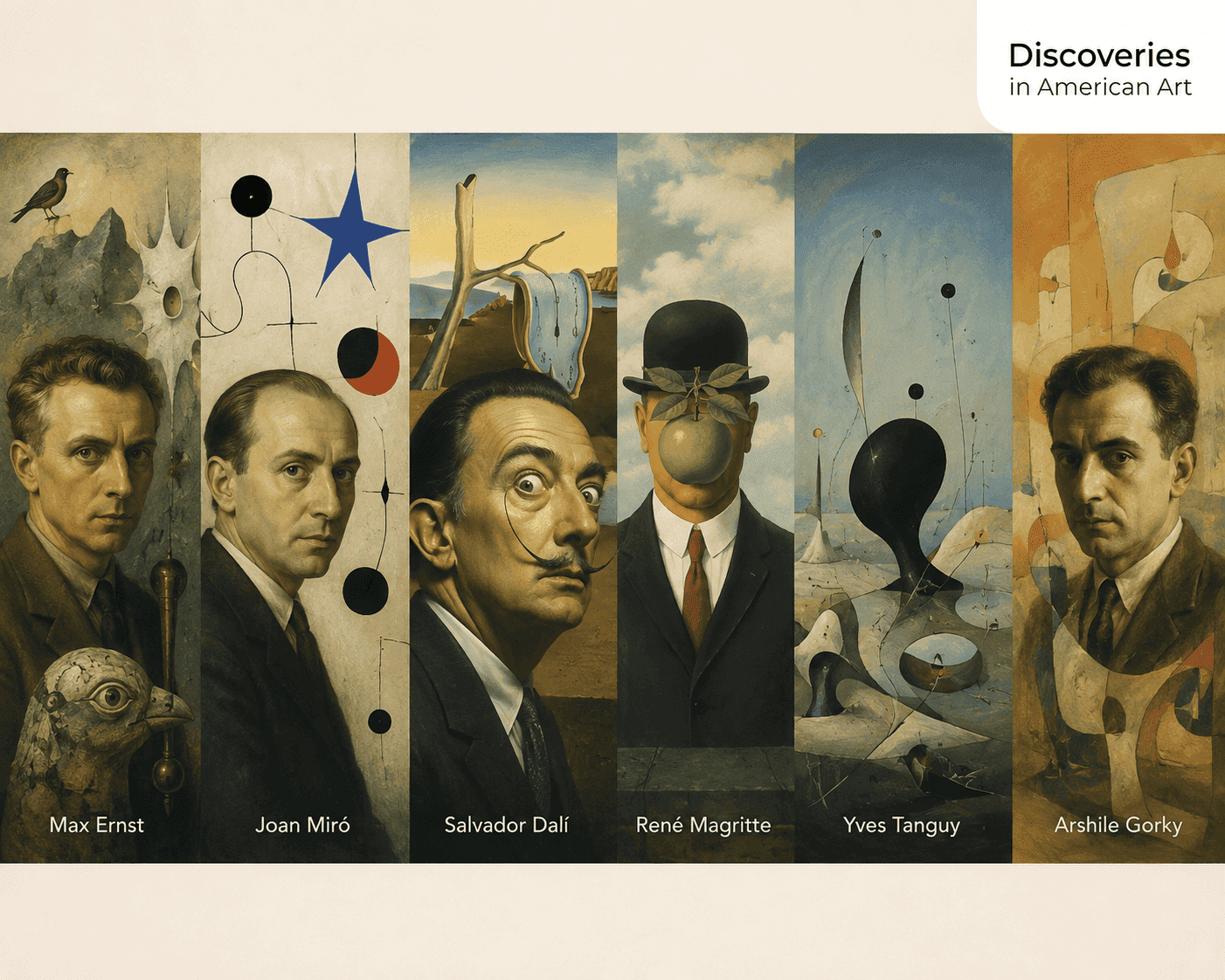
Artists such as Max Ernst, Joan Miró, Salvador Dalí, René Magritte, and Yves Tanguy helped establish the visual vocabulary associated with Surrealism. Their experiments with symbolism, dream imagery, and unconventional visual relationships transformed modern art.
The influence of Surrealism extended far beyond Europe. In America, artists including Arshile Gorky absorbed Surrealist ideas and helped bridge the movement toward later forms of abstraction. These connections contributed to the development of many painters whose work combined psychological imagery with expressive gesture.
The result was a broad spectrum of artistic approaches that continue to influence contemporary painting today.
Artist Estate Discoveries
One of the most rewarding aspects of our work involves identifying paintings that have remained hidden within artist estates for decades. These collections often contain works that were never exhibited publicly, never professionally catalogued, or never offered for sale during the artist's lifetime.

Rare and Unpublished Works
Many estate discoveries reveal bodies of work that expand our understanding of an artist's career. Paintings once stored in studios, attics, or family collections may document periods of experimentation that were largely unknown to scholars and collectors.
We regularly encounter surrealist expressionist paintings from artist estate discoveries that demonstrate originality, technical accomplishment, and historical significance despite limited public exposure. In some cases, these works provide entirely new perspectives on an artist's development.
Estate discoveries are valuable not simply because they are rare. They are valuable because they preserve artistic voices that might otherwise be overlooked.

Provenance and Authentication
Provenance remains one of the most important factors in evaluating estate-discovered artwork. Exhibition histories, correspondence, studio records, family archives, and photographic documentation all contribute to a painting's historical record.
At Discoveries in American Art, provenance research and authentication are essential components of every evaluation. Our goal is to establish as complete an understanding of the artwork as possible before it enters the marketplace or becomes part of a larger rediscovery project.
Why Collectors Seek Estate Pieces
Investment and Rarity Value
Collectors are often drawn to estate-sourced works because they provide access to paintings that have not circulated repeatedly through galleries, auctions, and private sales.
Many surrealist expressionist paintings from artist estate discoveries remain closely connected to the artist's original body of work. This direct connection can provide stronger historical context, clearer provenance, and greater opportunities for research.
More importantly, estate collections often contain paintings that challenge established narratives and introduce collectors to artists whose contributions deserve greater recognition.
Featured Estate Discoveries
Our inventory changes as new collections become available. Featured works may include paintings influenced by Surrealist symbolism, psychologically driven imagery, expressive abstraction, and hybrid approaches that resist traditional categories.
These estate discoveries frequently represent works that have remained outside public view for many years.
For current availability, pricing, and collection information, please contact us directly.
Our Acquisition and Authentication Process
How We Verify Estate Works
Every estate collection presents a unique research challenge. We begin by examining provenance, ownership history, exhibition records, archival materials, and any available documentation connected to the work.
Where appropriate, we compare paintings with related works, historical records, and known examples from the artist's career. This process helps establish authenticity while placing the work within its proper historical context.
Many surrealist expressionist paintings from artist estate discoveries require careful evaluation because they emerge from collections that have remained private for generations. Thorough documentation helps ensure that these works are understood accurately and responsibly.
Submit Your Estate Collection
Have you inherited paintings that may reflect Surrealist, Expressionist, or related artistic influences? Are you responsible for an artist estate that has never been fully documented or evaluated?
Discoveries in American Art works with families, heirs, collectors, and estate representatives seeking guidance regarding appraisal, provenance research, cataloguing, and collection management.
Whether you are evaluating a single painting or an entire estate, we welcome the opportunity to learn more about your collection and discuss how we may assist with its preservation and interpretation.
Frequently Asked Questions
What are surrealist expressionist paintings?
These paintings combine elements commonly associated with Surrealism, such as dream imagery and symbolism, with the emotional intensity and expressive techniques often found in Expressionist art.
What does "artist estate discoveries" mean?
Artist estate discoveries are works uncovered within artist estates, family collections, studios, or archives that have not been widely exhibited, documented, or offered for sale.
How are estate-discovered paintings authenticated?
Authentication may involve provenance research, archival documentation, exhibition records, family histories, photographic evidence, and comparative study of related works.
Which artists are associated with surrealist expressionist influences?
Artists such as Max Ernst, Joan Miró, Salvador Dalí, René Magritte, Yves Tanguy, and Arshile Gorky contributed ideas that influenced this broader intersection of Surrealist and Expressionist approaches.
Why are estate discoveries valuable to collectors?
Estate discoveries often provide access to rare works with strong provenance, limited market exposure, and important historical connections to the artist.
Can I sell surrealist expressionist paintings from a family estate?
Yes. The first step is typically documentation, provenance research, and professional evaluation to better understand the artwork and its historical significance.
How do I know if a painting is genuinely surrealist expressionist in style?
Paintings of this type often combine symbolic or dreamlike imagery with expressive color, gesture, abstraction, or emotional intensity. Professional evaluation can help place the work within its appropriate historical context.