
 Quogue Gallery exhibitions have included brilliant but lesser-known painters of New York’s first-generation of AbEx painters such as Arthur Pinajian [1914–1999] a reclusive painter of lyrical abstract landscapes whose entire life’s work was nearly carted away in a Dumpster. This trash-to-treasure story was featured on ABC’s “Good Morning America” as “the unlikely discovery that has rocked the art world.” Also important among the other early AbEx painters with idiosyncratic approaches were Emerson Woelffer [1914–2003] and Ben Wilson [1913–2001]. Tops among the second generation are Fay Lansner [1921–2010], whose figurative expressionism focused on the feminine form; Jay Milder [b.1934], whose expressionism includes the figurative, cryptographic signs, and numbers. Also on the New York art scene were Raymond Hendler [1923–1998] and Vincent Pepi [b.1926], both gestural Action painters who began in the late 1940s.
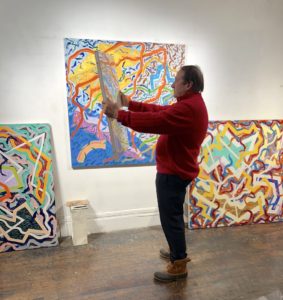
The Murray’s most recent rediscovery project concerns the works of Joan Thorne [b.1943], a third generation New York School abstract painter who art critic Stephen Westfall has dubbed a “New Image Abstractionist.” Quogue is featuring her works at Art Palm Beach January 16–20) and at Art on Paper in Manhattan (March 7–10), then culminating with a solo exhibition at the Quogue Gallery in July. Thorne was included in two Whitney biennials, was given a solo show at the Corcoran Gallery of Art in Washington, DC, and won the Prix de Rome. Quogue Gallery is focusing on her paintings from the 1980s — which were part of Barbara Rose’s seminal exhibition, “American Painting: The Eighties,” at the Grey Gallery at New York University. Westfall wrote, “Thorne’s sensitivity and exuberance with color renders the optical energy of her compositions delicious, or erotic, rather than jarring.” Seeing these nearly forty-year-old paintings with a fresh perspective reminds us why they received such laudatory reviews in the New York Times, Art in America, and ArtNews.